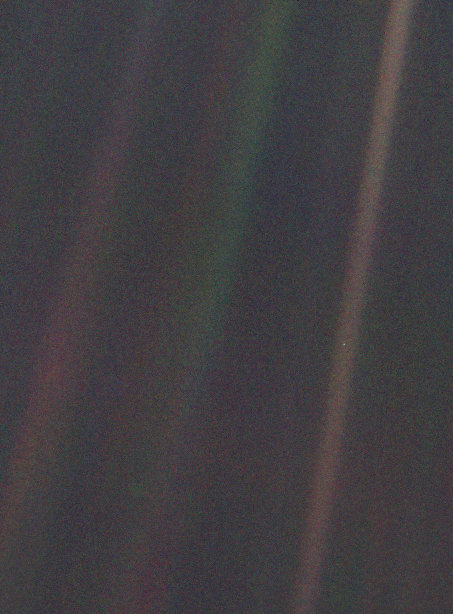
Voyager 1 & 2
Launched in 1977, Voyager 1 and 2 are the most distant human-made objects in existence. Voyager 1 is over 24 billion km from Earth - so far that radio signals, traveling at light speed, take nearly 22 hours to reach us. They carry Golden Records containing sounds of Earth for any intelligent life that might find them.
Grand Tour of the Outer Planets
The Voyager missions took advantage of a rare alignment of the outer planets that occurs only once every 175 years. This "Grand Tour" allowed a spacecraft to visit Jupiter, Saturn, Uranus, and Neptune using gravity assists. Voyager 2 remains the only spacecraft to have visited Uranus (1986) and Neptune (1989).
Communications System
Voyager's communications system uses S-band (2.3 GHz transmit) and X-band (8.4 GHz) to send data back to Earth. The 3.7-meter parabolic dish antenna points at Earth while other instruments operate. At current distances, signals arrive with only 10^-16 watts of power - requiring NASA's Deep Space Network to detect.
- Transmitter Power: 23 watts (less than a refrigerator bulb)
- Signal to Earth: 22 hours one-way at light speed
- Data Rate: 160 bits/sec from interstellar space
- Antenna: 3.7 meter high-gain dish
The Golden Record
Each Voyager carries a 12-inch gold-plated copper phonograph record containing sounds and images of Earth. Carl Sagan called it a "message in a bottle." The record includes: 116 images, greetings in 55 languages, music from diverse cultures, and sounds of Earth (wind, surf, thunder, animals, human heartbeats).
Discoveries
- Jupiter: First active volcanoes on Io, evidence of subsurface ocean on Europa
- Saturn: Complex ring structure, hydrocarbon lakes on Titan
- Uranus: Tilted magnetic field, 10 new moons discovered
- Neptune: Great Dark Spot, fastest winds in solar system
Interstellar Space
Voyager 1 crossed into interstellar space in 2012, Voyager 2 in 2018. They are now in the space between stars - the local interstellar medium. Still transmitting scientific data about cosmic rays, magnetic fields, and plasma waves, they will continue until their nuclear power sources deplete around 2025-2030.
Current Status (2024)
- Voyager 1: 24+ billion km from Earth, 22.5 hour signal delay
- Voyager 2: 20+ billion km from Earth, 18.5 hour signal delay
- Instruments Active: 4 of 10 original instruments each
- Power: RTG generators declining ~4 watts per year
Illustrations