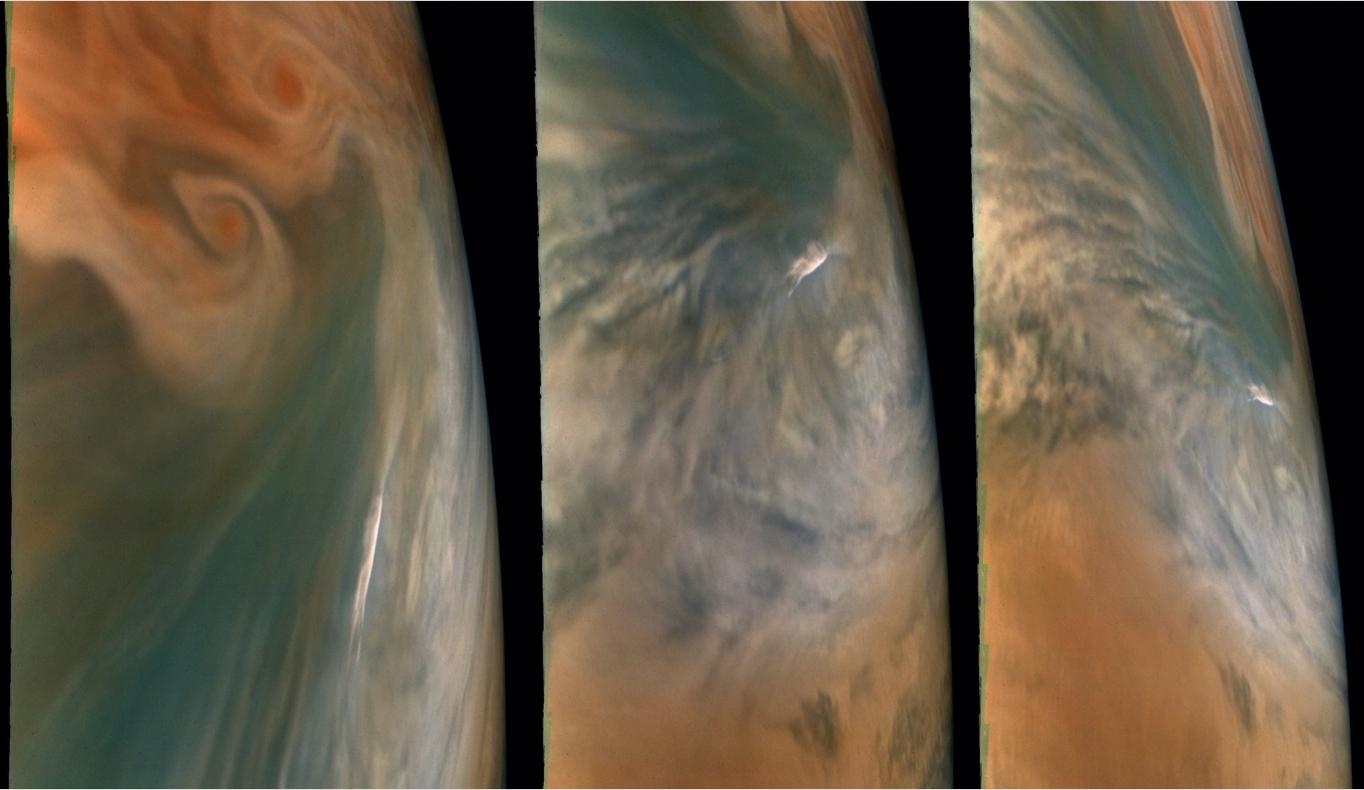
Juno
Juno is NASA's solar-powered Jupiter mission, orbiting the gas giant since 2016. Unlike previous Jupiter missions, Juno flies in a highly elliptical polar orbit, diving close to the planet every 53 days to study its atmosphere, interior, and powerful auroras.
Mission Design
Juno broke new ground as the first solar-powered spacecraft to reach Jupiter - the most distant use of solar power at that time. Its three solar panels, spanning 20 meters across, generate 14 kW at Earth but only 3-4 kW at Jupiter. The spacecraft's orbit is designed to minimize radiation exposure from Jupiter's intense radiation belts.
Science Objectives
- Atmosphere: Measure composition, temperature, cloud motion to 100+ bar pressure
- Magnetosphere: Map Jupiter's enormous magnetic field - the strongest in the solar system
- Auroras: Study Jupiter's powerful auroras - 100x more energetic than Earth's
- Interior: Probe the deep interior structure using gravity science
- Water: Measure water abundance in the atmosphere - key to understanding formation
Discoveries
- Deep Atmosphere: Water ice detected deep in atmosphere, challenging formation models
- Great Blue Spot: An ammonia-fueled anticyclone similar to the Great Red Spot but blue
- Shallow Lightning: Water-based lightning discovered in shallow clouds, indicating complex meteorology
- Magnetic Field: Jupiter's magnetic field is far more complex than anticipated
- Core: Evidence for a large, diffuse core or no core at all
Jupiter's Radiation
Jupiter produces intense radiation in its van Allen belts - 20,000 times more energetic than Earth's. Juno's orbit is carefully designed to pass over the most dangerous regions. The spacecraft's titanium vault protects its electronics, but the Juno team still manages radiation damage to instruments over time.
Communication
Juno communicates via a 2.5-meter dish antenna with NASA's Deep Space Network. At Jupiter's distance (628-930 million km), signals take 35-52 minutes one-way. The spacecraft's Jupiter Orbit Insertion required a 35-minute engine burn to slow down by 2,100 km/h.
Illustrations